Overland Park is rewriting its zoning code
FrameworkOP, the city's adopted comprehensive plan, calls for vibrant neighborhoods with a variety of housing types and attainable options for residents at every stage of life. The UDO rewrite is how the city delivers on that commitment. The city is consolidating 33 zoning districts into 11. The decisions made now will shape housing options, affordability, and neighborhood life for a generation. We're tracking the process, analyzing every draft, and advocating for a code that matches the city's own vision.
March 12: Public Open House (4–7 p.m. at Matt Ross) April 30: Deadline to take the official city survey
The city's own data makes the case
The January 2026 Housing Needs Assessment, presented by city staff, establishes the factual foundation:
FrameworkOP's Housing Goal calls for "vibrant neighborhoods with a variety of housing types that offer attractive, attainable, and safe housing options." The Housing Needs Assessment numbers above show the city is not on track to meet that goal.
The market study says one thing, the code draft says another
The RCLCO market study identifies structured parking costs as a key barrier to the types of compact, walkable development the city says it wants. VTPI data shows suburban surface parking runs $11,000 to $14,000 per space in land and construction costs alone, before annual operating expenses.
Despite this, the code outline says it will "carry forward" existing parking standards. This makes no sense when neighboring cities are moving forward: Lawrence just eliminated parking minimums citywide, Kansas City (KS) suspended them, and Kansas City (MO) removed them downtown.
Where the new districts help
- Simpler code: Consolidating 33 base zones into 11 makes the process more predictable for everyone.
- Missing middle progress: The Neighborhood 1 district lists cottages, duplexes, and townhomes as "supported" uses, a meaningful step away from strict single-family zoning. This aligns directly with P-LU.5 (Increase Housing Choices) and P-H.4, which calls for missing middle housing and pocket neighborhoods as tools for diversifying the housing stock.
- Better commercial areas: Neighborhood Center and Regional Center districts will allow underperforming auto-oriented centers to transition into mixed-use hubs. With a 20.9% office vacancy rate, this is critical. (A Kansas City-specific Urban3 analysis found mixed-use yields 10x the tax revenue per acre compared to auto-oriented development.)
Where the critical details are missing
The Childcare Gap
Despite a shortage of over 14,000 childcare slots in Johnson County, the draft use list of 35 specific categories entirely omits childcare. It must be explicitly permitted by right.
"Supported" vs. "Permitted"
The code lists diverse housing types as "supported." If this means by-right approval, it will work. If it means discretionary review and lengthy hearings, very few will get built.
Vague Administrative Flexibility
The outline mentions a staff-level modification procedure. For this code to succeed, administrative approval must be the default for projects that meet objective standards.
These gaps run counter to specific FrameworkOP action items. A-LU.1.C directs the city to "remove regulatory barriers that impede the development of a diversity of housing types and price points." A-LU.1.J directs the city to "address barriers to missing middle housing and infill development." A-H.5 directs the city to revise regulatory standards that create procedural barriers to missing middle housing. These are adopted action items, not aspirational suggestions. The code draft needs to follow through.
What this means for renters
- Legacy development: If older apartment complexes are branded "nonconforming," renovations become nearly impossible. The new "legacy development" category could protect this crucial housing stock. This connects to P-H.2 (Support Aging and Established Neighborhoods) and A-H.2, which directs the city to monitor factors that impact the retention of attainable housing.
- The family definition: The current code limits households to four unrelated people, a rule that penalizes roommates and non-traditional families. The rewrite must remove this cap. A-LU.1.C specifically directs the city to "remove regulatory barriers that impede the development of a diversity of housing types and price points." An occupancy cap based on family relationships is exactly that kind of barrier.
- Tenant protections: The draft code leaves rental licensing out of the UDO, squandering a chance to directly tie zoning rights to building quality standards.
The state legislature adds urgency
SB 391 recently passed the Kansas Senate (31-7) and had a House hearing. It would prohibit cities from requiring landlords to accept housing vouchers. If the state continues narrowing tenant protections, the local zoning code becomes our most vital tool for ensuring housing access.
Our Proposal
Our proposal is organized around three key areas that align the UDO with the city's adopted vision, using objective, predictable standards.
Housing Variety
Permit duplexes, townhomes, and cottage courts by-right. Legalize ADUs citywide. Reduce minimum lot sizes to make starter homes and infill development feasible.
FrameworkOP: P-LU.5, A-H.5, A-H.6
Affordability
Eliminate parking minimums in walkable areas. Modernize occupancy rules to focus on health and safety, not an outdated definition of "family" that restricts how people live.
FrameworkOP: P-LU.4, A-LU.1.B, A-LU.1.C
Neighborhood Life
Allow small-scale, neighborhood-serving shops with design standards. Require new developments to include functional common spaces like plazas, courtyards, and pocket parks.
FrameworkOP: P-LU.9, A-QOL.2
What to Do Next
The UDO rewrite is happening right now, and the rules are changing.
1 Take the Official Survey
Tell the city you support eliminating parking minimums, allowing neighborhood commercial, and permitting duplexes by-right. The deadline is April 30.
Take the Survey →2 Attend the Open House
Join the open house on March 12, from 4–7 p.m. at the Matt Ross Community Center. Ask the consultants how "supported" uses will actually be approved.
Want the full evidence?
Our research page lays out the data, the comparable city precedents, and the policy analysis behind our reform recommendations.
Explore the ResearchUDO Rewrite Timeline
The city's UDO rewrite is a multi-phase process spanning from Winter 2024 through Fall/Winter 2026. Public hearings and workshops are key moments for resident input.
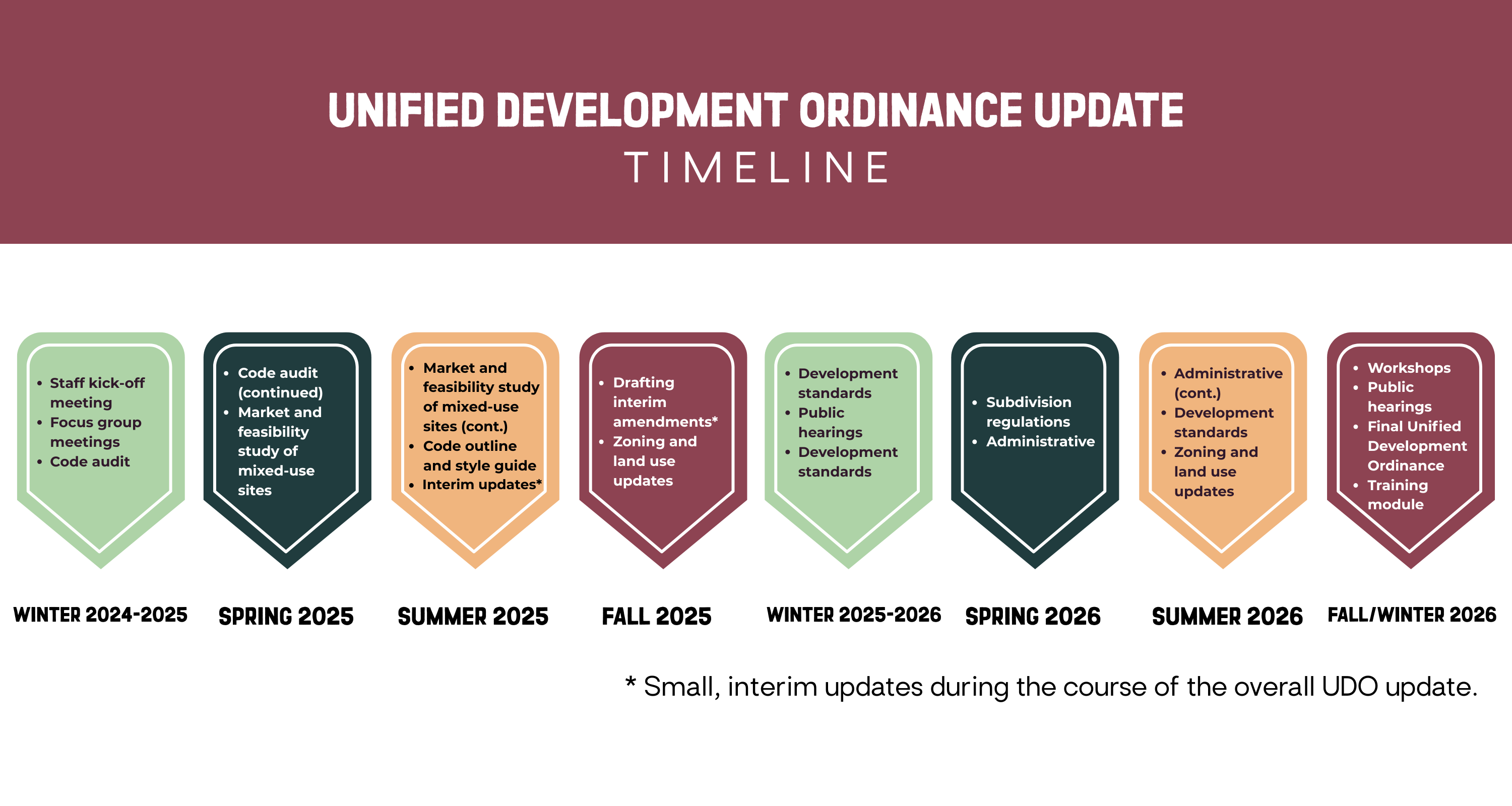
Source: City of Overland Park Planning & Development Services
Our Proposal Is a Public Resource
Our structured proposal is a public resource for the residents of Overland Park. It is grounded in the city's own adopted plans and supported by publicly available data. Have questions or want to share feedback? We'd like to hear from you.